The Pub Next Door had sold. The sale had been brokered by a leading Hotel Broker on behalf of an absentee mortgagee.
The price paid by the buyer was 10% less than Mine Host's cash offer, leaving a very sour taste in Mine Host's mouth. The broker was Cain & Abel Pty Ltd, one of the state's leading Hotel Brokers, with a supposedly impeccable reputation.
The vendor was a Melbourne loan shark, as mortgagee-in-possession. The loan shark had engaged a Melbourne real estate agent to handle the sale. The Melbourne real estate agent, lacking local or industry knowledge, had in turn engaged Cain & Abel hotel brokers, at the time supposedly one of Qld's leading hotel brokerage firms.
Mine Host, being next door in the Wayside Tavern, and on the hunt for another pub, should have been considered a "hot" prospective purchaser, and immediately been targeted by Cain & Abel.
Mr Cain (of Cain & Abel) revealed the upcoming sale to Mine Host only when Mine Host phoned on another matter. Thus alerted to the sale, Mine Host immediately requested an inspection.
It was to be another Two months before an inspection could be arranged. Even then it was by accident (receptionist was out & Mr. Cain had answered the phone himself)
Soured from Two months of unreturned phone call exasperation, Mine Host took this window of opportunity to arrange an immediate inspection.
That night Mr. Cain phoned and to say that unless an unconditional offer (above a certain amount) was made by midday the following day, Mine Host was "out". (This is not normal procedure for commerical transactions)
Three working hours to arrange an unconditional cash bid for the neighboring property?
Mine Host met this ultimatum. Mr. Cain then manufactured a disagreement over the size of the deposit. Mine Host's intended deposit was $100,000 Cain & Abel demanded $150,000 or Mine Host was "out".
The lawyer handling this matter for Mine Host was not the usual partner at Golf, Racing & Gladhanding, but an offsider. A migrant lady with a very strong accent. The amount of hotel sale work done by G.R. & G. meant their relationship to the Cain & Abel was a tad too close for Mine Host's comfort.
There were many meetings between Cain & Abel and G.R. & G's foreign-accented Associate, all on other matters, at which they occassionally took the opportunity to cover the minutia of Mine Host's attempted transaction. Mine Host was none too comfortable at the reverent tone adopted by the foreign-accented Associate when referring to the firm of Golf, Racing & Gladhanding.
Disagreement over the deposit amount would have been brief, lasting only a few hours. Cain & Abel needed only this briefest possible time to get a contract to the preferred buyer, thus making the sale a fait accompli.
In subsequent discussion with the very heavily foreign-accented Associate, Mine Host wryly observed that the firm of Cain & Abel had acquitted themselves with neither honour nor decency, that indisputably they had not acted in the best interests of their client.
The heavily foreign-accented Associate took umbrage at this slight on the (reverently referred to) firm of Cain & Abel and proceeded to give Mine Host a thorough dressing down.
The dressing down wasn't a direct one, but a "commerical transactions for dummies" lecture.
Taking quite a bit of offence - at recieving a lecture on commericial etiquette from one whose commercial experience was purely vicarious, and at the strident siding with the (indispuably unethical) opposition, by someone who is supposedly acting for him - Mine Host immediately dismissed the law firm of Golf, Racing & Gladhanding.
Tuesday, November 17, 2009


Friday, November 13, 2009
Marching Orders part 3
Mine Host had received a ticket. It arrived in the mail.
Penalty: Several Hundred Dollars.
Offence: Refusing an inspection of the Premises.
Regulatory Authority writing the ticket: Fire Brigade (in a city hundreds of miles away).
Being as the Fire Brigade had not, via any of the following methods, indicated they wished to inspect the Wayside Tavern:
Fax,
Telephone Call,
Letter, posted,
Letter, couriered,
Messenger Boy,
Attending the Premises in person,
Carrier Pigeon,
Smoke Signal,
(in this day & age, to this list one would add "email"),
Any other method one can think of,
Mine Host made the assumption that being as the ticket was on the unreasonable side of unjust, it would be easily contested.
Mine Host met with his solicitor-of-the-moment and laid the facts before him.
Mine Host instructed his lawyer (the firm's senior partner) that he considered the ticket to be unjust, unreasonable, vexatious, lowdown, cheating, disgusting, insulting, a mongrel act, etc etc etc, and that he wished to challenge it in court.
The law firm in question did quite a lot of this sort of work, though mostly with tickets written by the police.
The legal advice provided on the spot to Mine Host was to make no response, and the matter would proceed to court.
On the spot Mine Host raised the question that this advice was in diametric contrast to the "How to Respond" instructions on the back of the ticket.
The solicitor (experienced in these matters) repeated his advice.
Mine Host complied with the advice. By failing meet the deadline for response to the ticket the matter became an automatic judgement against Mine Host, was not able to be defended and Mine Host was a de facto defaulter and had to pay the fine plus an extra penalty.
Consequently Mine Host never again contacted that law firm, who at least had the good grace to never send a bill, for that or any other work. The senior partner in a remarkable display of self-preservation - or perhaps in a display of shame uncharasteric for his profession - has ever since managed to keep out of Mine Host's sight.
Since that date relations between Mine Host and the Queensland Fire Brigade have been of a most frigid nature.
Thursday, October 29, 2009
Marching Orders part 2
Mine Host requested an advice from a lawyer. He contacted his (then) current law firm and was directed to a smart young lawyer specialising in the field in question.
The requested advice was: "What are the implications and downside to winding up "Shelf Company X"?
Shelf Company X was a small company that had been used by Mine Host in the past. It had no assets, had not traded for several years, yet had suddenly become the target of a massive claim by the Tax Office, for a figure well into Six digits. (How Shelf Company X got into this predicament will be covered in another post)
At the time Mine Host was thousands of miles away in a new career, working more hours than a human should be awake, and did not want to engage in litigation against the ATO.
Especially as:
If he won: He got nothing except a massive legal bill.
If he lost: He had to pay the massive Six figure sum and he got a massive legal bill.
The smart young lawyer sent Mine Host a very long written advice. He covered many topics, but made no mention of the implications of winding up the company.
Mine Host phoned & wrote to the lawyer, restating the initial request.
The Smart Young Lawyer sent Mine Host another long written advice, covering many topics, but again made no mention of the implications of winding up the company.
Mine Host contacted the Lawyer again, ensured the lawyer understood his simple request and once again the Smart Young Lawyer sent a long written advice.... (and so on and so forth).
This went on for several exchanges. Mine Host grew rapidly more impatient. Time was wasting.
Eventually in exasperation Mine Host contacted the overseeing partner at the law firm and in-a-manner-that-could-not-be-mistaken instructed the partner that he was-sick-to-death-of-the-Smart-Young-Lawyer giving advice-on-everything-under-the-sun-except what he had been asked.
Shortly thereafter Mine Host received the advice he requested.
The advice: (abridged) "If the company is dissolved nothing will happen. The sole creditor is the ATO, and they won't be able to grab anything. Your troubles will be over"
The time take to produce the Two Paragraph Advice: One Month
The bill: $20,000.00 (due to the large amount of written advice provided)
Mine Host severed relations with that law firm just as soon as Shelf Company X was dissolved.
Sunday, October 18, 2009
Marching Orders part #1
A couple of months ago Legal Eagle and Mine Host discussed briefly the matter of clients not feeling their lawyer is entirely on their side.
The matter of dismissing one's lawyer cropped up. Mine Host has form in this area.
It was suggested that Mine Host may have been blaming the lawyer for Mine Host's failure to not disclose all details of his case. Hmmm.... read the next few posts & see if the lawyer or the client who was out of order.
One of the messier partings was from a Brisbane law firm with a double-barrelled name, quartered in a high rise office tower.... Messy because it took a while.
This firm had been Mine Host's "law firm", giving advice & acting for him in various matters, one such matter being an asset purchase.
This asset came with a few clapped out but registered, vehicles. It was the lawyer's duty to ensure the transfer of Motor Vehicle Registrations.
The asset transferred smoothly, as did the ancillaries, including motor vehicles.
However registrations of these motor vehicles did not transfer to Mine Host. The (annual) registrations subsequently expired without renewal notices having arrived.
Mine Host telephoned to the Department of Transport & enquired as to when he could expect the renewal notices (and new registration sticker to affix to the window).
The Department, upon learning the registration number (on the "Number Plate" affixed to the front and rear of the vehicle) refused to continue discussions, stating the motor vehicles were registered to another party, and the Dept. was not at liberty to discuss the registrations with an "outside party".
Furnishing the Department of Transport with proof of ownership made no difference. The Dept. could discuss the registrations only with the holder of those registrations.
Mine Host contacted the lawer at the firm with the double-barrelled name, explained what had happened & asked for him to sort the matter out.
Nothing changed.
Some time later Mine Host contacted this lawyer to find out why he was not getting satisfaction, and asked to see a copy of the transfer form that had been lodged with the Department of Transport.
Nothing was forthcoming, and whenever Mine Host phoned, the lawyer was not available.
Emails to the lawyer likewise went unanswered.
Two Years later Mine Host gave up emailing the lawyer.
Eventually a sympathetic clerk at the Motor Vehicle Registry informed Mine Host that at time of transfer a submission had been recieved from the seller, but not from the buyer (that would be Mine Host).
Not revealing who held the registrations, the clerk asked Mine Host if he knew a certain person. Mine Host did, the person was a former employee of the vendor. There was no fathomable explanation for why this person held the registrations.
Mine Host made contact with this fellow, who was by now most confused, being stuck with vehicle registrations he knew nothing about.
The renewals had not been delivered in a timely fashion, and the registrations were now in default.
Of course a simple transfer from the current holder to Mine Host, now possible, would have resolved the matter, however the matter should never have arisen in the first place, and the other fellow was in all the trouble that comes with "defaulting" on a government debt.
Mine Host, by now well & truly tired of a lawyer who did not return phone calls or emails, made a most robust phone call to the big name law firm, explaining in a very matter of fact voice the situation he was in, with particular emphasis on the fact that Two Years had now passed, and the situation that an innocent party was in, possibly all due to inaction by the lawyer at the time of transfer.
Another partner took the call and discussed the matter with Mine Host, undertaking to find out what had happened. Some time later this other partner provided Mine Host with the original of the motor vehicle registration transfer form. It clearly showed that the registrations should have been transferred to Mine Host...... It had never been lodged.
Mine Host expressed to this other partner his disappointment with the law firm.
The law firm sent a bill for $660 for forwarding the (unlodged) transfer form.
The Department's debt collection lawyer had been sooled onto the bunny who had been lumbered with the regos. This lawyer, now armed with the original of the transfer form, instructed the Queensland Government to transfer the registrations to Mine Host, expunge the other fellow from the registration records, to expunge all mention of any "default", to cease all action against the other fellow, and to reverse any action that had been taken. Furthermore the department was to immediately notify the hapless fellow of this.
What had happened at time of transfer?
Someone, with only one of two matching forms, had read the back of the vendor's transfer form, and taken his "agent or servant" to be the person to whom the registrations were to be transferred.
Mine Host no longer uses that hyphenated-named law firm.
Saturday, October 17, 2009
Beyond words
Uncle & his best friend joined up at the start of the war. They trained together & were posted to the same infantry unit in Malaya. When Japan entered the war the fighting went badly and retreat was ordered.
Uncle was shot in the legs in one of the first clashes with the Japanese army. He was unable to walk, and such was the urgent pace of the retreat that he was among those left behind by their own unit.
Uncle & other men unable to walk were laid in the shade in a sheltered position, their mates propped canvas shades over them, Uncle & his mate shook hands and parted.
One can only imagine what were the thoughts & the mood of the men who retreated south leaving their mates to the Japanese. In later years the only comment on the matter from Uncle's mate was gruff & along the lines of: Had they known what the Japanese treatment of prisoners was to be, they would never have abandoned them.
The wounded men lay abandoned, unable to move, pondering their fate. Hours later they heard the approach of the Japanese army. For most of a day they could hear, but not see, the Japanese carefully making a systematic approach to what would have seemed to be an Australian position.
When Japanese scouts ascertained there was no military threat, the Japanese came in full force. It was made plain to the wounded men that they must march, or be beaten.
None could walk, so Japanese soldiers got stuck into them with rifle butts. It was made plain to the Japanese officer commanding that none of the Australians could walk. The Japanese officer replied that the Australians would march, or the beating would continue.
Most of the skin on the front of Uncle's face had been lifted in a 3-cornered gash, & hung down over his face. His nose, brow ridges and teeth & jaw were smashed, giving him the appearance of being dead. The Australians were pushed together by the Japanese, Uncle was not grouped with the others, presumably he was believed dead.
The Japanese became tired of wielding rifle butts. A tripod mounted machine gun was positioned facing the Australians, and fired continuously into the collection of wounded & immobile Australian soldiers. Then Japanese soldiers advanced forward and bayonetted any who had survived the machine-gunning. The men who were still alive lay still & feigned death, even as they were bayonetted.
After the machine-gunning and bayonetting many were still alive. Uncle & other survivors lay still. The Japanese then poured petrol onto the dead & living Australians and ignited it.
It was dark by this time, & uncle was able to make it into the nearby long grass & into the forest. He was unable to walk, unable to see, & unable to eat. The first 30 days of wriggling on his stomach through the jungle were the hardest.
When recaptured several weeks later, he was wasted enough to not be expected to live, his injuries were in a very serious state.
He recovered in Changi jail, and spent most of the war on the Burma Railway.
At war's end he returned to his home. His eyes had a look in them that caused all & sundry to pause & reflect.
Uncle rarely spoke of the war, always wore long sleeves & long trousers, and became practised at training his hair so that though it appeared to be in an untidy state from him performing manual labour, was actually carefully trained to cover the maximum amount of scarring.
Uncle was one of those who never purchased a Japanese car, and never worked for an employer who dealt, even peripherally, with a Japanese company.
On the difficulty of years later and after a wartime of events, identifying which Japanese officer or soldier committed which atrocity, and the unreliability of identifying the actual perpetrator, he stated that "Hanging any Japanese officer is a good start...", his eyes making it plain how extensively he thought war crimes trials should proceed....
Uncle would have no part of any suggestion of a national reconciliation with Japan, and on occassion walked out of a job without another word rather than be in the presence of one who believed that Japan's wartime record should be treated with tact.
He never exhibited bitterness toward people who seriously urged him that Japan should be treated with tact. In fact he never exhibited anything, simply never responded to any further contact from them, ever.
Uncle went to his grave maintaining that the Japanese were a very intelligent and very dangerous species of monkey that was able to interbreed with humans. This was not an obtuse expression of bitterness, it was his acknowledgement that huge numbers of individual Japanese had over many years, performed acts which no human could have committed.
Friday, October 16, 2009
The expert Touch
It may not be widely known, but in the years just after the war quite a number of Dutch national servicemen were demobbed in Australia. Several of these men worked on the same sawmill as Mine Host's grandfather. This was in the days when immigrants were required to work a minimum of 2 years in the bush, at a labouring job dictated by the government.
Mine Host's Aunts were keen pianists, playing every day for hours.
These ladies each have now retired from a lifelong career as music teachers, and still play daily, now with more than 70 years on keyboard. A record of which they are justifiably very proud.
As many musicians are, they were fanatic as teenagers, and played for hours each day. The sawmill workers were able to hear the piano notes coming from the cottage.
One day one of the Dutchmen ventured to the door of the cottage, and asked the lady of the house, in very broken English, that he had been listening each day to the playing, and how nice it was, and would the girls mind if he "had a go himself"?
Graciousness dictated that he be invited in, for a cup of tea & then he sat down at the piano and demonstrated skill on the piano that silenced the household. His playing brought goosebumps to the backs of the girls necks.
Prior to being conscripted, he had in Europe been a concert pianist. He was most grateful for the opportunity to play.
Why he had chosen demobbing in Australia, followed by years of unaccustomed rough labour on a bush sawmill, was an unexplained mystery. He was in the company of his countrymen (the sawmill was mostly Dutch) but was in possession of a skill that would have better served him in Europe.
His playing was such that to this day the Aunts are in awe of the playing that afternoon in the sawmill cottage.
Tuesday, September 29, 2009
Pull on the Wheel and Yell "Whoa"
Joining up in the first flush of volunteers in 1939, Uncle found himself in the Lighthorse. An accomplished horseman, bushman, self-reliant, physically both adept and experienced, he fitted in very well.
.....then the Lighthorse was mechanised.
Like many who are highly capable with anything that had hair or hide, snorted and was bigger than you, Uncle was hopeless with machinery of any sort (rifles excepted) and incapable of adapting.
As handy as Uncle had been when mounted on a horse, as a driver he was reciprocally as disastrous.
On his enlistment form Uncle had stated that he was a sleeper-cutter. This was a reserved occupation.
The Army now "discovered" that Uncle was in a reserved occupation, and promptly discharged him.
He spent the war as he had spent the 1930's: In the bush, cutting railway sleepers by hand.
For the next 65 years he maintained immaculately his issued Lighthorse accoutrements and uniform. When recently he passed on, the Emu feather in the slouch hat was the original.
Tuesday, September 15, 2009
All The Way
Like most people Mine Host is uncomfortable when confronted with a victim of severe burns. Even years after their recovery, sighting (or even thinking of) the victim brings to life the torment of what severe burns must feel like.
All of us have experienced minor burns (from a stove etc) and the imagination horrifically multiplies this experience.
A cousin, though functioning as a member of society, spent most of his life bearing the all-too-obvious scarring of severe 3rd degree burns to much of his body (the visible parts anyway) including his face and hands.
Cousin had a brief career in the RAAF. A radio operator in a Wellington bomber crew, what turned out to be his last mission (and final task in the RAAF) came very early in the war.
Hit badly after a bombing mission to mainland Europe, his Wellington ditched. Upon the skipper's advice that ditching was unavoidable, Cousin commenced transmitting a distress signal, advising their imminent fate and estimated position.
After the crash into the sea, he remained at his station, transmitting continuously, with no way of knowing if his signals had been heard.
He kept transmitting as the bomber burned around him, leaving it only when fire destroyed the radio equipment.
The crew was rescued, unharmed (radio operator excepted).
It is not known if his transmitting until the final moment helped their rescue. Had he got out of the crashed bomber with the rest of the crew, he would not have been burnt.
He received several years of rehabilitation, Three service medals, and a discharge into civilian life.
Morse code, his most marketable skill, was not available to him, his fingers no longer able to tap it out.
Even though he lived an ordinary and decent life, as most of us do, his presence at family gatherings always prompted everybody to (at some stage) privately reflect with their own thoughts.
The Mongoloid visage of one who has had their face burnt off is possibly the most unsettling of all burns injuries (for those of us who have not been burned)
All of us have experienced minor burns (from a stove etc) and the imagination horrifically multiplies this experience.
A cousin, though functioning as a member of society, spent most of his life bearing the all-too-obvious scarring of severe 3rd degree burns to much of his body (the visible parts anyway) including his face and hands.
Cousin had a brief career in the RAAF. A radio operator in a Wellington bomber crew, what turned out to be his last mission (and final task in the RAAF) came very early in the war.
Hit badly after a bombing mission to mainland Europe, his Wellington ditched. Upon the skipper's advice that ditching was unavoidable, Cousin commenced transmitting a distress signal, advising their imminent fate and estimated position.
After the crash into the sea, he remained at his station, transmitting continuously, with no way of knowing if his signals had been heard.
He kept transmitting as the bomber burned around him, leaving it only when fire destroyed the radio equipment.
The crew was rescued, unharmed (radio operator excepted).
It is not known if his transmitting until the final moment helped their rescue. Had he got out of the crashed bomber with the rest of the crew, he would not have been burnt.
He received several years of rehabilitation, Three service medals, and a discharge into civilian life.
Morse code, his most marketable skill, was not available to him, his fingers no longer able to tap it out.
Even though he lived an ordinary and decent life, as most of us do, his presence at family gatherings always prompted everybody to (at some stage) privately reflect with their own thoughts.
Tuesday, September 08, 2009
I won't if You don't
Continuing the series of daily posts of small WWII snippets, as they happened to his family, Mine Host recounts this hearsay yarn from one of his uncles:
Uncle, in the army and with a very low NX service number (two digits, beat that!) was serving in New Guinea in the Engineers. Being a bush worker accustomed to solving his own construction/logistic dilemmas apparently made him ideal Engineer material. He was asked to forge a link, this he did (no problem for the son of a blacksmith) and that's how he found himself in the Engineers.
Uncle's army tales are mostly around One of Two themes:
1/. How little he thought of anyone who abused rank, particularly if the same specimen then threw themself at the feet of anyone with an extra stripe on their sleeve or pip on their shoulder. And,
2/. How hopeless most soldiers (Engineers mind you) were at basic Engineering tasks, ie, setting up a block & tackle and things like that.
Uncle enjoyed the Engineers' problem-solving, but the abuse of rank caused him to loathe the army and every day he spent in it. At Six foot Six inches, barrel chested, arms like telegraph poles, and with a "behind the saleyard for Sixpence, place your bets" bare-knuckle background (the 1930's were a tough time, to drive a gentle compassionate man to such a base source of income), Uncle's solution to fools & irritators in the bush (not that he had many, at that size) was to warn 'em, then just flatten 'em.
One can imagine how much it rankled such a man to be subject to the Army rank structure and physical inferiors who took their opportunity of a lifetime and issued petty commands to the "big fella" because rank allowed them to.
The story: On foot patrol in New Guinea. Bringing up the rear of his section, Uncle was mostly looking backward. As the section moved on, he glanced upward, and saw a Japanese soldier perched high in a tree.
The Japanese had his rifle carefully aimed at Uncle, and clearly had been covering him for some many seconds. The distance was quite close. Uncle and the Japanese stared directly into each other's eyes.
Neither man said anything, both sets of eyes remained locked on the other. Uncle continued pacing backward to keep up with his section.
Uncle could see in the eyes of the Japanese that the Japanese did not want to die, or to be involved in a shootout, likewise the Japanese no doubt could see the same in Uncle's eyes.
Neither man gave any hint that would have alerted Uncle's section to the situation.
Uncle kept backing away, both men kept their rifles and eyes on each other, until the section, and Uncle with it, moved out of sight of the Japanese.
In Six Years of war, this was the only contact he had with the enemy.
Uncle never joined the RSL, and never attended an Anzac Day parade. When his brothers urged him to take up both of those "rights" he explained, only once, that it was his right to not join, and his right to not march.
Such was the strength of his desire to forget the entire distasteful experience of war and having been in the army.
Monday, September 07, 2009
World War Two Snippet D
Reasons for joining up during wartime mostly revolve around Patriotism/Peer Pressure.
Try this reason:
One of Mine Host's uncles was a "scheme-a-minute" type. Always had a (new) business deal/scheme on the boil. In the new economic climate that magically appeared after hostilities broke out he thrived, or imagined he did. He hocked himself & his widowed mother's legacy to the hilt, & started trading in various wartime commodities.
As with any of his schemes that acutally got off the ground (ie, if someone was imprudent enough to finance him) he went bust in spectacular fashion, owing every last penny he had borrowed.
His widowed mother faced a severe reduction in circumstances, and he also.
In a move that surprised all the family, without any warning, just days before the dreaded interview with the bank manager, he joined the army. His mother & sister went along in his stead, braced for the worst. However the bank manager was inexplicably quite pleasant, explaining that the bank would be taking no action & they had unlimited time to "sort out" the mess (with no bank pressure, sister slowly solved the financial woes). When it was clear that they were puzzled at this change of direction by the bank, the bank manager cheerfully explained:
Banks were prohibited from foreclosing on anyone who had joined the armed forces.
Sunday, September 06, 2009
World War Two Snippet C
When hostilities broke out, amongst the many who joined in the first rush of volunteers was a newlywed farmer, a young man with much to look forward to, a loyal and pretty wife he was devoted to, a farm he was secure on, and a bright future.
Two years later he was killed in action.
His widow inherited the farm, and unable or unwilling to carry on, sold it, moved into town, then remarried. The fresh marriage was a happy one, with children.
Some time after the cessation of hostilities, in a country full of soldiers making their way home from the war, the husband turned up in town. Very much alive, and repatriated from the Japanese Prisoner-of-War camp where it turned out he had spent the war, he was ready to take up the life that had been suspended when he joined up.
Apprehensively arriving on foot at the farm (it was only a few miles from town) and not quite knowing what to expect after such an abscence without any communication, he made no sound and showed no emotion as the farmer who now owned his farm briefly explained matters.
The hollow eyes of the man who had experienced Two years on the front line, then Three and a Half years as a prisoner of the Japanese, looked directly into the eyes of one who had obtained his farm through remaining a civilian, as the civilian gave directions to the house in town where the wife now lived.
(This story is well known by Mine Host, as the man who bought the farm was his uncle)
Silently the returned serviceman tramped back to town, without having once put down the kitbag he carried. It contained the few possessions of one demobbed after repatriation from Changi.
Several hours later the farmer observed the returned serviceman trudging along the tracks to the water tower just out of town, to sit on the platform there.
Having walked to town, visited the house where the woman whose memory had sustained him through several years of captivity now lived with her husband & children, spoken with both of them, discovered that the proceeds of the farm sale had been dissipated through financial indiscipline, agreed that no aspect of the situation could be undone, then instead of walking to the railway station, walked along the tracks to the platform a few miles out, by what had been his farm.
He boarded the first train that stopped for water. It is not remembered now if it was an Eastbound or Westbound train.
Saturday, September 05, 2009
World War Two Snippet B
To improve his education opportunities, during World War Two Mine Host's father boarded in town. (though not far from home, only 11 miles).
He boarded in a house with 3 other urchins/larrikins his age, all were schoolfriends first, & later boarded together. Father, because he was from "too far" out of town, his best mate as he came from a large family & his mum had enough kids to handle alone after her husband joined up, & so on.
The housewife (& mother of some of the kids in the household) was also the sole grown-up in the menagerie. The houseful of kids needing care & discipline kept her mind occupied. Her husband (in his 40's) was in the Navy, posted as "Missing Believed Prisoner-of-War" (of the Japanese).
He remained a "believed prisoner" for the duration of the war. His fate being telegrammed to the house a few weeks after the Nagasaki Bomb.
The telegram confirmed that he had indeed been a prisoner of the Japanese, and that he was demobbed & on his way home. Only a few days later he arrived home. Apparently his arrival most poignantly reinforced something that was only just entering the national consciousness: ie, What it meant to have been a prisoner of the Japanese.
In 1946 the couple, in their 40's both, had another child, 12 years younger than the (previous) youngest.
The returned sailor passed on in the 1950's (a legacy of his treatment as a P.o.W.)
The children (including the 1946 model) have all since passed on, & every child who boarded in that wartime house has passed on (except one)
Epilogue to this tale, and the reason it is postworthy?
It has just been discovered by Mine Host Sr. that the woman he boarded with in WWII is still alive, and pretty much as sharp as she ever was. They haven't seen or heard of each other in almost 60 years. This is due to change shortly. (Thousands of miles separate, and dad doesn't travel as well as he used to)
Humble Correction: Dad travels very well, just that he "doesn't travel south in winter."
Thursday, September 03, 2009
What were you doing when............ ?
70 years ago today an event occurred that had very far-reaching implications, changing the course of history, and the lives of a significant portion of the world's population.
Some of those who remember the 3rd of September 1939 are still with us. Ask them their recollection of what they were doing that day. It is a recordable snippet of history.
Mine Host's father (a boy at the time) remembers the war starting:
The grown-ups gathered around the wireless as dusk approached. The kids gathered also & were required to be still.
The Prime Minister came on the wireless, gave a brief synopsis of the international events, ultimatums, rejections, etc. then solemny announced that as a consequence of the aforementioned events, the country and empire were now at war with Germany.
The grown-ups went very silent. And remained silent. The kids were put to bed, without a story. The grown-ups were to remain silent all night.
The kids knew something was up, by the silence, lethargy and deep contemplative mood of the grown-ups.
They wondered what "war" was.
The coming years were to demonstrate just what the word meant.
Thursday, August 27, 2009
El Gringo
 In South America on business, posting held up by confusion when this site kept appearing in Spanish, finally worked out how to log in to blogger, in Spanish.
Am still having a fair bit of strife making the "@" on the Spanish keyboard. "A-ha-ha-ha Gringo fools, all the best with trying to email back to the Gringo world. We've made the oh-so-essential "@" symbol ever so difficult to find on the keyboard, and when you do find it, good luck with trying to type it - A-ha-ha-ha-ha-ha-ha, not so easy is it?"
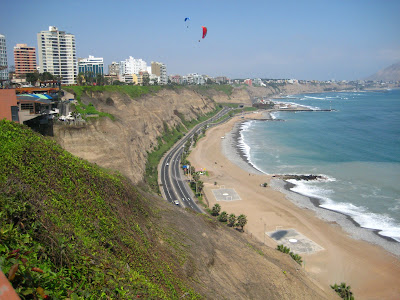
Here is a nice snap of the Cliffs of Lima, to be getting on with.
Apparently sunshine & rain are both equally rare in in the (mist-laden) city of Lima, making this photo, with actual sunshine rather a rarity.
Thursday, July 30, 2009
In a World of Their Own
As many others besides Mine Host will know, conversation with a police officer (even of high rank) often leads one to the conclusion that an entry requirement to the police is to fail an intelligence test.
For blokes who are supposed to be "trained investigators" quite a number exhibit awareness skills akin to those of a wooden plank.
Mine Host would be wealthy indeed had he a gold bar for each time a police officer of the rank of Sergeant, Senior Sergeant, or Inspector has said to him: "You pubs fill people with grog, then when the punter's pocket is empty of coins you throw them out onto the street, and create a police problem."
It takes a special arrogance, a belief in the superiority and in the infallibility of one's own opinions, and no sense of shame or embarrassment (not to mention crass stupidity) to make such a statement in public.
Mine Host long ago gave away the notion that promotion to Sergeant & above meant an officer had some street smarts & savvy. Actual contact of an official nature with officers ranked Sgt & above put paid to that. Some of them are as dumb as a box of rocks.
In a Constable this is manageable, in a Sgt or Inspector who turns out backward enough to believe the above statement should be a serious policing policy, it can become a tedious problem.
For as anyone who has any dealings with the liquor industry (except it would seem, a whole lot of senior cops) is well aware, as far back as 10 years ago RSA laws (Responsible Service of Alcohol) closed the door on the flimsy claim that such circumstance was the norm.
Friday, July 10, 2009
Chassis lives on, but the Motor is long dead.
 Mine Host feels a touch of pride to see in one of Australia's leading museums an exhibit made up entirely of possessions/artifacts of one of his ancestors. Above is an odometer-less business vehicle. Below some household stuff:
 Included in the exhibit were quite a lot of photographs, revealing that some of Mine Host's Aunties were among the most good looking sorts in their discrict, perhaps the entire colony.
Wednesday, July 01, 2009
Know Your Place, Harlot!
New chef is a muslim. Mine Host barely takes any notice of this. As a believer in religious freedom (specifically Mine Host's freedom from ALL religions ALL of the time) Mine Host cares not which carved idols/ethereal spirits his staff pay homage to.
Muslim staff tend to be polite, diligent, ethical and "bat for the team". This one however is of a breed previously not encountered by Mine Host. He is Bangladeshi. Mine Host has long experience only with Indian, Pakistani, homegrown and Turkish muslims (as staff).
This Bangladeshi has a hard-core attitude toward female humans that is straight out of a Saudi Mosque. Sheikh Hillbilly himself in Sydney wouldn't exceed this level of mysogyny.
For the Bangladeshi isn't rude to women, he just plain acts as if they don't exist. Operating with a female kitchenhand (refusal to recognise women doesn't extend to forgoing the fruits of all the mundane work they do) he walks around as if she does not exist.
No matter how heavily encumbered, she must jump out of the way, as he acts like a shunting railway locomotive. Either she moves, or he will roughly shoulder her aside.
Matters continued as so for a few days, until word reached Mine Host.
Mine Host noted the following day's roster had a different kitchen hand, also female, dark skinned and a migrant.
Specifically, a Maori lady from New Zealand.
Neither Mine Host nor anybody else was present when New Chef gave her the inevitable evil glare and (it would have been only an attempted) rough shove out of the way.
New Chef subsequently presented with an unspecified injury of sufficient severity to prevent him from working for a few days, claiming it as a "gym injury" and most anxious that Mine Host not think the injury happened at work.
New Chef is now gracious and polite to ALL females, ALL of the time, and defers readily to their advice on anything and everything. At work in the kitchen, he is almost bowing to any and all kitchenhands, and most visibly does not go anywhere near them nor hamper them in any way as they go about their duties.
Thursday, June 25, 2009
On the House! (by law)
A customer knocks off $90 from the Wayside Tavern when the staff are not looking, swifly exiting the premises.
The theft is captured in high resolution digital video format by the camera surveillance system.
The customer denies the offence.
The customer/offender is then advised to pay the $90 to avoid police involvement.
A month passes, no payment is made. Police are called.
The offender then writes a letter (written by a solicitor) admitting nothing, offering to pay $90 as a "goodwill gesture" on the condition Mine Host withdraws the complaint to Police.
$90 is the only currency acceptable to Mine Host. The letter is ignored.
In court the offender pleads guilty, but says he has no memory of the incident as he was "too drunk to know what was happening"
(This contrasts with the video evidence, where he is shown consuming Two glasses of beer in Two hours, reading the newspaper, then furtively glancing left/right before committing the offence.)
The Magistrate imposes a fine of $400.
The court handled the debt to society, but ignored the debt to the Wayside Tavern.
Until the $90 is paid, the offender will be refused admission, for eternity if need be.
The average citizen will try to tell you that Magistrates have brains, perhaps even common sense.
A claim not supported by decisions such as the one above.
Friday, June 19, 2009
*Oink*Oink*
People not turning up to work is the bane of the hospitality industry.
People not turning up to work and blithely expecting to keep their job is one of the amusing anomalies of the hospitality industry.
Actual reasons for not turning up to work:
Too lazy to get out of bed,
Too drunk,
Had a party to go to instead,
Took lots of drugs and didn't wake up in time,
etc etc etc.
Reason given to the boss for not turning up to work: "Sick".
The day after blowing a shift, they all take action to retain their job. Thus Mine Host has quite a collection of "medical certificates" (issued by a tame doctor the day after the no-show for work) stating "an unspecified medical condition"
For staff who live on the job this is more difficult. There are credibility issues if one spends the day exhibiting boisterousness in a hale and hearty manner at home, whilst simultaneously claiming to be too ill to make it downstairs to for work.
The husband of a couple living and working in the pub, a big hearty chap, (Three weeks into the job and fast approaching his "use-by" date - even more faster now) failed to front for work yesterday.
It was as if he had been abducted by aliens, he was absent, his wife knew nothing (or may have known something as some people, and she is one, are inarticulate to the point where they are incapable of giving a straight answer to anything, even if they want to)
Today he appears (having thought first to pop into the handiest GP's surgery) brandishing a medical certificate stating "an unspecified medical condition".
Mine Host, who knows very well when someone is too ill to work, eyeballs him and says "Big strong man like you, bouncing up & down the stairs yesterday and this morning, too crook to work - in a pig's eye!"
Straight-faced and without a hint of guile, he states "I thought I might've had Swine Flu, played it safe & checked"
You couldn't make up stuff like this!
This time next week he won't be on the payroll.
Saturday, June 06, 2009
Queen's Birthday
Mine Host breaks with the protocol of this blog & tells a tale that did not happen to him in person:
In 1954 Mine Host's father was in the Army & tasked with Royal Guard duty in Sydney, for the occassion of the Royal visit.
Each day they would follow exactly the same routine:
At 2am they were marched into position along a parade route. They stood in position from 2am, at attention, lining the route until mid-morning/midday/early afternoon when Her Majesty passed by.
Shortly after the motorcade conveying Her Majesty had passed they were dismissed by an officer & were then on leave until 2am the following day. (use one's own imagination to fill in the details of this daily leave)
The first day nobody knew what to expect, so the troopers were armed with a .303, bayonet and Three rounds each, to handle any "attack that may be launched upon Her Majesty".
It was patently obvious the first day that by far the greatest risk Her Majesty faced was being swamped by enthusiastic loyal crowds.
Thus the second & subsequent days the .303 and bayonet remained in the armoury. Instead, dressed in full webbing only, each trooper gripped the belt of the trooper to either side, forming what was (hopefully) an unbreakable khaki chain, in an attempt to keep the adoring crowd from crushing Her Majesty & party.
Subscribe to:
Posts (Atom)